Riverside Toronto
TOUR: Riverside Landmarks and Hidden Gems
Toronto’s Riverside neighbourhood is home to some of the city’s most iconic landmarks and hidden gems. We’re taking you on a self-guided tour featuring rich histories, classic architecture and some lesser known spots that you can check out for yourself!
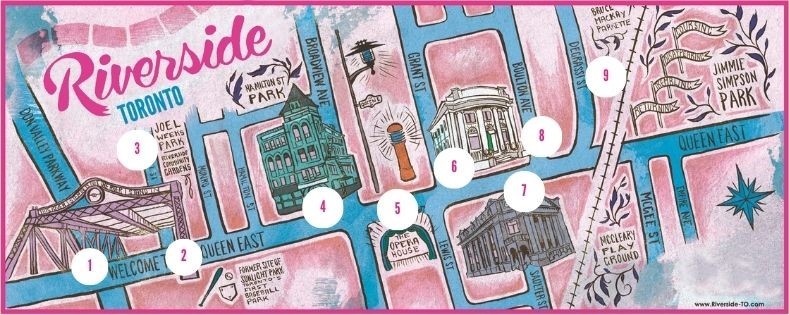
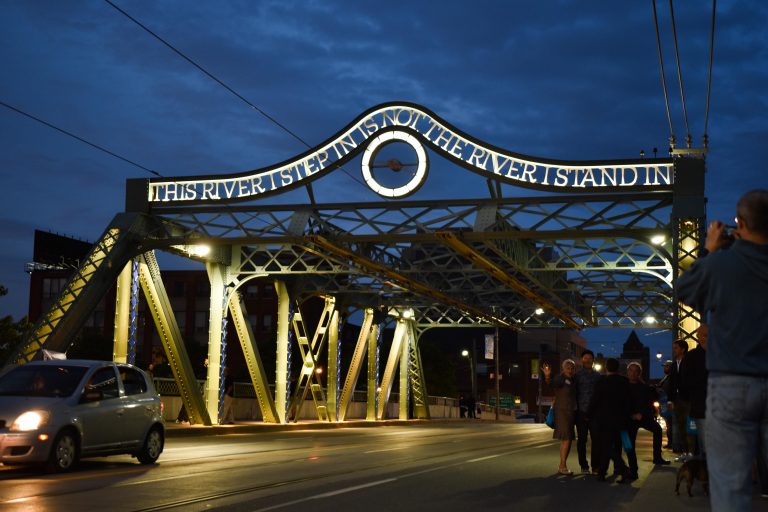
STOP 1: The Riverside Bridge
Queen St East between River St & Davies Ave
Known officially as the Queen Street Viaduct, the bridge over the Don River was first built as a wooden bridge in 1803 before it was reconstructed with steel to its current state, opening in 1911. The “Time: and a Clock.” art by Eldon Garnet was added atop the bridge in 1996 as a project with the then Queen-Broadview Village BIA (now Riverside BIA) – the art referencing Greek philosopher Heraclitus’ quote “This River I Step In, Is Not The River I Stand In”. Ever since 2015, the bridge and its art have been illuminated at night as a result of the Riverside BIA’s Gateway Bridge Project.
Photo Credit: City of Toronto
STOP 2: The Smith Block
639-655 Queen East
Originally a grand central hall with a total of nine properties, the Smith Block’s central tower burned down in the 1960s. The Block was designated by the City of Toronto Council in 2017 as being of “heritage and cultural value” for their Richardsonian Romanesque designs with brickwork, arches, windows, and stone details.

STOP 3: Joel Weeks Park
10 Thompson St
Joel Weeks Park opened in 2012 after extensive community consultation and design by Janet Rosenberg Architects. The park was named after Joel Weeks, a local boy who passed away tragically in 1982 at the age of 8, playing in the previous Don Mount community housing area before there were any safe play areas. This unique park provides the community with an open green space and includes a playground with a water feature, community gardens, the vibrant Don Mount Basketball Courts, and the Echo public art sculptures.

STOP 4: The Broadview Hotel
106 Broadview Ave
Known for its Richardsonian Romanesque style, pyramidal tower, and terra cotta relief sculptures on the facade, The Broadview Hotel was first established in 1891, as a hall built by Archibald Dingman before its ownership and use changed to room rental for factory and rail line workers in 1907. In the 1980s-2000s, the building was a rooming house while hosting entertainment clubs before the building was bought by Streetcar Developments in 2014. It was reopened in 2017 and operates as The Broadview Hotel with boutique rooms, event spaces and restaurants including The Rooftop with the best views of Toronto’s skyline in the city.
Photo Credit: The Opera House
STOP 5: The Opera House
735 Queen St East
Established in 1909 as La Plaza Theatre – an Edwardian vaudeville establishment – it later became a movie theatre from the 1930s. In 1989, new ownership transformed it into The Opera House – a 950-person capacity music venue that has hosted countless music genres and artists over the years including Metallica, Eminem, and Tom Jones. The location has also been heavily used for film, TV, and music videos.
STOP 6: Stephan Caras Int’l Headquarters
744 Queen St East
The long-time headquarters and fashion house of Canadian designer Stephan Caras, the building has a Neo-Classical architecture style. Originally built in 1905 as the Canadian Bank of Commerce, this building was designed by architects Frank Darling and John Pearson, who also designed the Ottawa Peace Tower of the Parliament buildings.
STOP 7: Ralph Thornton Centre & Queen/Saulter Library
765 Queen St East
Constructed in 1912 and designed by E.J. Lennox, the architect behind Old Toronto City Hall and Casa Loma, this building was known as Postal Station G until 1975. The City of Toronto acquired the building, and in 1979 it was renovated into the Ralph Thornton Community Center, Queen/Saulter Library Branch, and South Riverdale Child-Parent Centre. Today it still houses those community uses and is a vibrant hub of programming and events.
STOP 8: Poulton Block
798 Queen St East
Built in 1885 for William B. Poulton, it was designed in a Gothic Revival style. It was initially used by the Masonic Orient Lodge and acted as an ‘Orient Hall’ on its third floor until 1912. The first Toronto Public Library ‘Eastern Branch’ was located in the back of the building, which is now home to Amber Kitchen & Coffee and has a vibrant public art mural by birdO on its north facing wall along Boulton Ave.
STOP 9: De Grassi Street Workers Cottages
De Grassi St (North of Queen East)
Workers Cottages were originally built for workers near the area and were seen as ideal housing with their functioning windows, indoor sanitation, and separate bedrooms for children. The architectural cottage style originated from a 1851 one-storey house model that was shown at the great Crystal Palace Exhibition in London.
If you take this tour and post on social media, we’d love to see! Be sure to tag us: @riverside_bia
Be sure to follow @riverside_bia on Instagram and check the Riverside Blog for regular updates on the neighbourhood! Stay tuned for more tours in this series coming soon!
The post TOUR: Riverside Landmarks and Hidden Gems appeared first on Riverside Toronto.