Gripped Magazine
Polar Circus: The Ice Climb That Took Eight Days on the First Ascent
In the heart of the Canadian Rockies, rising directly above the Icefields Parkways between Banff and Jasper, lies one of the most storied ice routes in the world: Polar Circus. With 700 metres of elevation gain, 500 of which are pure waterfall ice, it has long been regarded as a crown jewel of North American ice climbing. Its accessibility, scale, and dramatic architecture have elevated it to classic status, prompting guidebook author Joe Josephson to call it “the showpiece of the Canadian Rockies and a must for all climbers.” Yet its legendary reputation was forged not in one push but in an eight-day road-to-road mission during its first ascent in the winter of 1974/75 by brothers Allan and Adrian Burgess, Bugs McKeith, and Charlie Porter.
The lower section of Polar Circus begins innocently enough from the valley floor, only a short walk from the highway. Climbers encounter a series of pitches with brief vertical steps that funnel into the narrowing walls of the gully above. Early parties often chose to bypass the first six pitches entirely by skirting the left hillside and traversing onto the route below the first rock band. Above this entry lies the first major challenge: a long pitch with a steep section near its top. Polar Circus only gets more difficult from here.
Halfway up the climb sits one of the most mythical features in Canadian ice climbing: The Pencil. This six-foot-wide, 150-foot free-hanging icicle, rated WI6 when it forms at all, rarely appears fully, and even when it does, few climb it. During the first ascent, the icicle hung precariously above a mushroomed ice pedestal. The inaugural team wisely avoided climbing it directly, instead ascending a hazardous 100-foot pitch up the right side of the pedestal, beginning with vertical ice before easing back to 70°. It was here, on the steep ground beneath The Pencil, that American climber Charlie Porter famously grumbled about the chaotic belay setup, referring to it as a “Polish circus.” The misheard phrase quickly morphed into “Polar Circus,” giving the route its name.
Above The Pencil, the character of the climb shifts to one of exposure and risk rather than technical difficulty. Several large, steep snow bowls, well known for their avalanche danger, force a long, committing traverse. The terrain threads past scattered trees and into the main upper basin. Along this traverse sits a narrow cave with a trickle of water, but the superior shelter lies 150 feet above: a 50-foot-deep cave with a dry, sloping floor. During the 1975 ascent, this high cave became the key bivouac site, offering shelter from the hazards and wind.
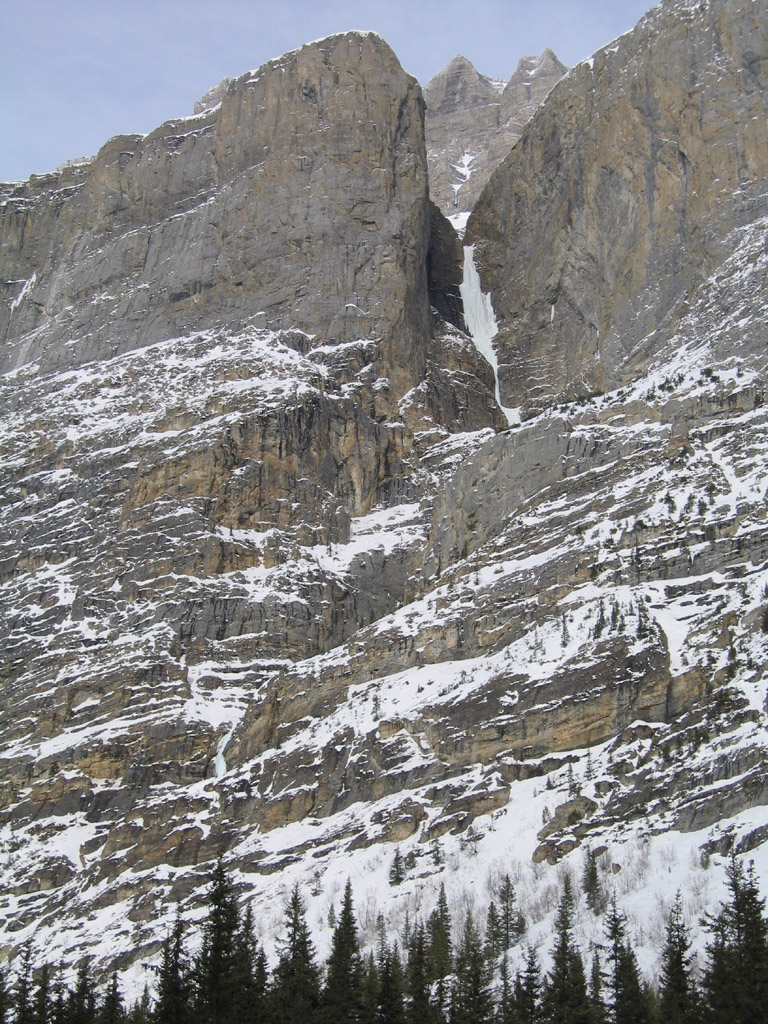
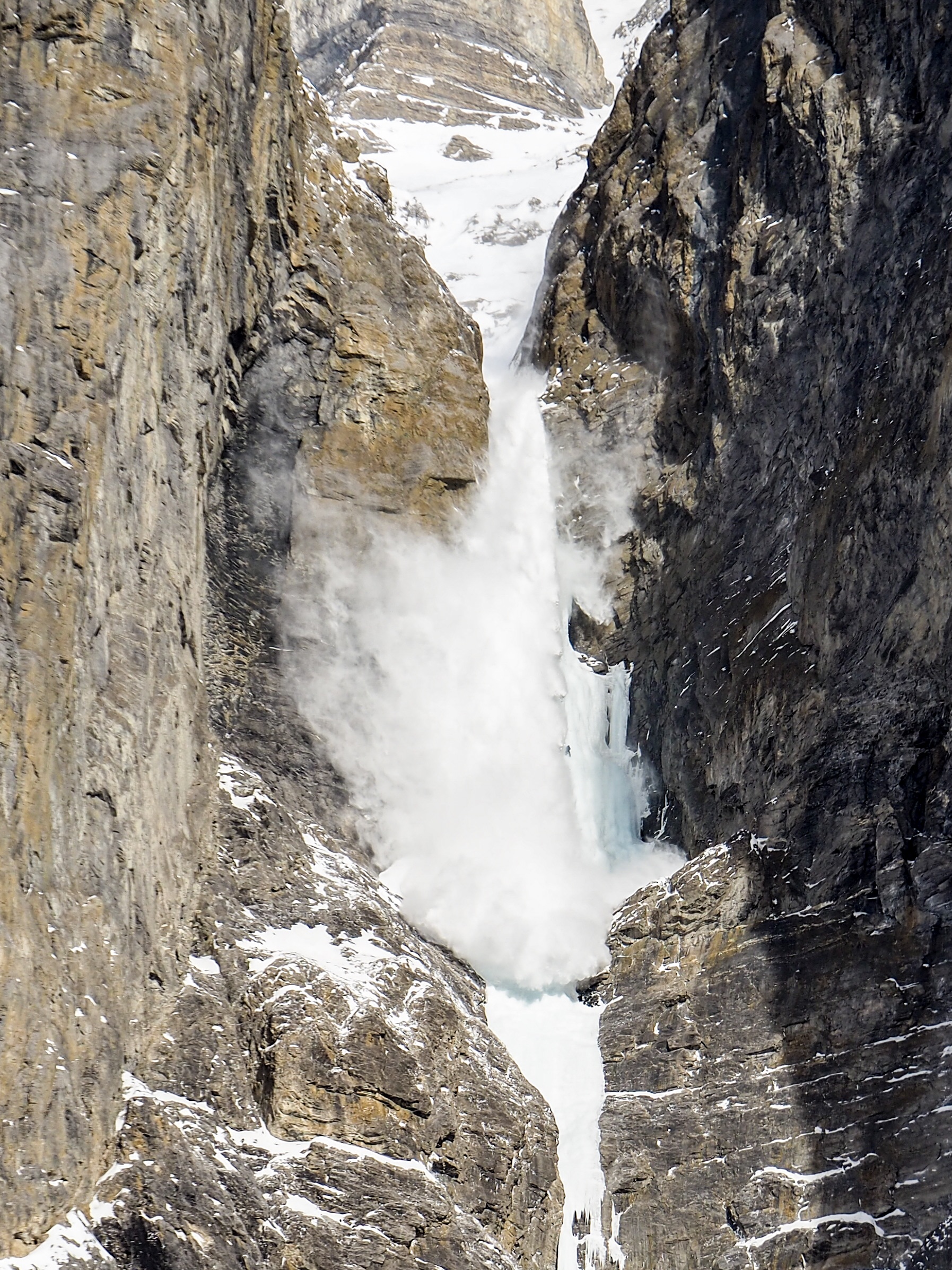
The final 750 feet of Polar Circus rise between two massive 1,000-foot rock walls, an enormous amphitheatre of ice divided into three distinct tiers. The first stretches 250 feet, averaging WI4 and WI5, punctuated by vertical steps. The second, 200 feet high, begins with a narrow vertical pillar, eases, then steepens again before depositing climbers onto a broad ledge at the base of the final tier. There, four vertical pillars tower above the snow, leading into the last 100-foot section of ice, often running with water even in deep winter. The final steps emerge into a snow-filled canyon that opens into the enormous avalanche basin below the southwest face of Cirrus Mountain.
The first ascent started on Dec. 17, 1974, and lasted until Jan. 3, 1975. It was a siege-style effort employing fixed ropes, aid, and team work in midwinter conditions. What is now climbed in a day was then a limit pushing undertaking. The second ascent was led by Canadian Laurie Skreslet, literally following in the 1st ascent teams foot steps, done in two days and all but the last short bit of it free.
The team’s adventure transformed Polar Circus from an unknown gully into a world-renowned line, setting the foundation for its legacy as one of the greatest ice climbs of North America. Two days after the first ascent, Laurie Skreslet, Eckhard Grassman and Mike Lailey finished the route, after only five days, free climbing all but around 10 feet.
In 1982, cutting-edge climber John Lauchlan was killed in an avalanche attempting to solo Polar Circus. Since then, there have been several tragedies on the route, which is why every climber considering it as an objective should read this first. Barry Blanchard completed Lauchlan’s dream in 1988 when he made the first solo, writing after: “I had soloed a number of waterfalls in the last month and I was enjoying it. I loved the freedom. The constant motion, always climbing, never belaying, and never being cold. I always need the fear, but in just the right amount. I have no interest in overdosing.”
For regular Rockies ice and mixed climbing conditions updates follow the local Facebook page here.
The post Polar Circus: The Ice Climb That Took Eight Days on the First Ascent appeared first on Gripped Magazine.