Gripped Magazine
What Do Climbing Gym Setters Think About Boards?
Many of us who climb owe so much to the setters at our gyms. They introduced us to countless firsts — our first desperate crimp, first terrible foothold, first dyno, first mantle, first thank-God jug after a techy sequence, and countless other holds and movements.
As climbing continues to grow in popularity, so too do the ways in which we climb and train. In 2005, climbers were introduced to the MoonBoard – a full climbing kit with standardized holds and a pre-determined layout that allowed Ben Moon’s training system to be replicated. More than 20 years have passed since then, and this revolutionary idea gave rise to other boards like the Kilter, Tension, and Grasshopper, to name a few.
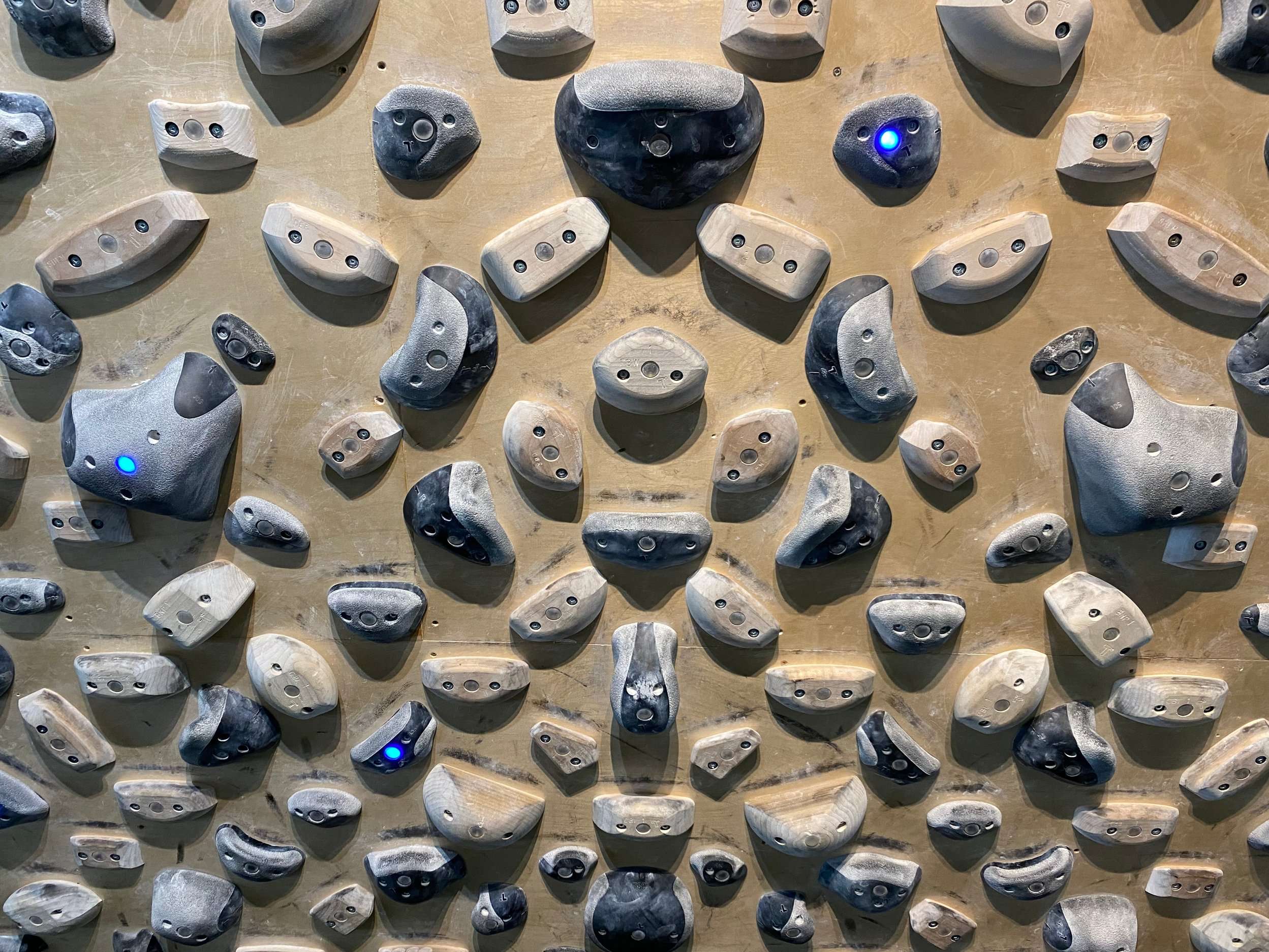
While a level of expertise is required to properly assemble and install a board in a gym, it is not necessary to have a setter. The holds don’t need to be moved once secured in the wall. The change in movement comes only from the imaginative ways in which the climbers use the holds. If you have never climbed on an LED board system, usually, the board is paired with an app. You can select different problems on the app, and the holds for each problem are then illuminated on the wall. You can even choose your own holds and create your own problems. It is possible to train your endurance by setting circuits, power by creating dynamic sequences, fingers or pinch strength with the selection of particular holds, and so on. It’s very much like climbing on a spray wall, but it removes the need to create your own problems or have friends identify holds with a laser pointer.
Because boards don’t require regular re-sets by setters to create new problems, we wondered how setters at gyms feel about the technology. What do they think about the emergence of board-only gyms? Do boards fundamentally change the role of setters? What value does commercial setting provide that boards cannot?
We interviewed two head setters at Canadian gyms, Max Summerlee and Karlo King. Summerlee is the Director of Routesetting at two gyms in Ontario – The Guelph Grotto in Guelph and The Core in Cambridge. King is the head setter of Climb Base5 in North Vancouver as well as a setter at Ground Up in Squamish.

We asked Summerlee and King about their thoughts on boards and the rise of all-board gyms. “They’re sick,” said King. “I personally have never been to an all-board gym, but the way I feel about board climbing is that it’s a tool. It’s a great training tool. But I don’t think it’ll ever replace commercial setting. It’s a very specific kind of movement that you get on boards. I think they’re great for climbers who want to train their fingers, for example.”
Summerlee echoed King’s enthusiasm, saying, “Boards are great. I really like board climbing. They’re a wonderful training tool.” He added a caveat, “They force a very specific type of climbing, and it makes people really strong. For me, sometimes I look at it like running on a treadmill versus running on the road or a trail. You’re getting everything you need. You’re working your muscles, and you’re probably going to get huge health benefits out of it. But for a lot of people, it just doesn’t have that same experiential impact that doing the real thing does. A lot of people don’t like them, and the climbing can be hard and intimidating.”
Summerlee added more context: “From a gym usership perspective, [a board] might require a 16-foot section of the wall that I can get one person on at a time. So, from a use of space perspective, it might not always be the best to designate space in a gym for a tool like that. You can understand why gyms would make the decision to move everything into a board room or simply have board-only climbing. And I think those gyms are super important. They’re also a really smart and unique way to capitalize on retail spaces that don’t have the requirements for commercial climbing in its full magnitude.
“In Asia, that’s been a trend for a while where you have a tiny, few hundred square foot gym, run by just one person or even nobody sitting in the desk. It’s just spray fill [or boards] in there and you go in and climb to your heart’s content and leave. It’s just a really great usage of a main floor lobby in a condo, for example, where nothing else would fit. So I think it’s brilliant. From a making-money perspective and a space-usage perspective, it’s great.
“I think it adds a lot to people’s climbing routines. I’ve seen so many people, become just absolute monster strong rock climbers from the time they spent on the board. I know people that only want to climb on the boards because it’s the type of climbing that suits them. They can climb hard and try hard things without the extra effort of moving around too much in the gym or doing crazy dynamic movement. There’s definitely trends to more dynamic styles of climbing on these boards, but it’s definitely strong climbing versus this competition-style, dynamic, coordinated movement that you’re seeing a lot of.”
Summerlee also painted an interesting picture of the various ways he uses boards as training tools for his setting team.
“We do audits of our setting,” he explained. “As [my team gets] through a rotation of the facility, whether it’s routes or boulders, we’ll do an audit of a circuit or a grade range as a team. We’ll climb all of our blue circuits in the gym (our third lowest circuit) or we’ll climb all of the 5.11 or all of the 5.9 [routes], for example. And then we’ll do a full audit on them, and I actually do the same thing with the Kilter Board. It’s almost like a base reset.
“Athletic empathy is something that route setters struggle with all the time. Understanding their own strengths and coming to a problem without that experience can be one of the biggest challenges. We have access to two different MoonBoards and one Kilter Board. I often get my setters to take a moment during audit weeks to get back on the boards, to just refresh themselves on what the benchmark for a V3 or a V5 or a V7 might be.
“I don’t think that the benchmarks on any of those boards are necessarily the be-all end-all of those grades, but it does give you a really good touch-grass moment where you can be like, ‘Ah, that is a V3. Maybe that shouldery move that I really want to [set] isn’t quite the right thing for this grade.’
“I encourage my setters to use the board whenever they can. I encourage my setters to set on the board and then share their climbs. I don’t want them to lose touch with the fact that it’s a really important tool.”
Finally, we asked Summerlee and King to share their thoughts on the value for climbers of having a team of setters create new problems every couple of weeks, rather than relying solely on boards and spray walls.
“In a sense, system boards feel like variations on a theme versus entirely original compositions,” said Summerlee. “Many system walls have relatively standard ranges of overhanging angles and have no dihedrals, so by the nature of the environment, there is so much more that can be done with boulders set by a team in a standard gym environment versus on a system board. You work with what you have on a system board, but setting in a gym, the possibilities are pretty endless – move something a half inch this way, rotate it 5 degrees that way. None of that is possible with a system board.”
“I think the best boulders and routes come from collaboration,” said King. “It’s special having a diverse team of different skilled climbers with different body types forerun something. It’s important to have open conversation about things like, ‘Oh, yeah, that hold does feel funny,’ or ‘That move kind of feels awkward, let’s experiment more.’ Having a good, cohesive team will just make the product better. The collaborative process is so important for something to be the best it can be.”

The post What Do Climbing Gym Setters Think About Boards? appeared first on Gripped Magazine.