Gripped Magazine
How We Arrived at Alex Honnold Free Soloing Taipei 101
In advance of Alex Honnold’s planned free solo of Taipei 101, let’s take a brief look at the historical development of climbing buildings, tracing its evolution from rooftop traditions to modern skyscrapers.
One of the earliest documented climbers in buildering was Geoffrey Winthrop Young, an accomplished alpinist and writer. In 1895, while at Cambridge University, Young began climbing the roofs and walls of college buildings. Although students had been climbing university architecture for years, Young was the first to document these activities systematically. He published a guide to climbing Trinity College, presenting routes, techniques, and observations in a format borrowed from mountaineering literature. In 1905, while serving as a master at Eton College, he produced a second buildering volume that deliberately parodied the tone of alpine guidebooks.
During the same period, buildering also appeared in a more public and commercial form. In 1905, Harry H. Gardiner began climbing buildings throughout Europe and North America. He completed more than 700 ascents, typically wearing ordinary street clothing and using no specialised equipment. His climbs attracted large crowds and helped establish the figure of the professional building climber. Around 1910, George Polley began his own climbing career after being offered a suit of clothes in exchange for reaching the roof of a building. Polley went on to climb more than 2,000 structures before his early death from illness.
Buildering in New York City reached its peak between 1915 and 1920. The rapid construction of tall buildings created new opportunities for climbers, and several individuals became locally famous for their ascents. At the same time, the risks were significant. A number of climbers fell to their deaths, and by 1920 municipal authorities had moved to outlaw the practice.
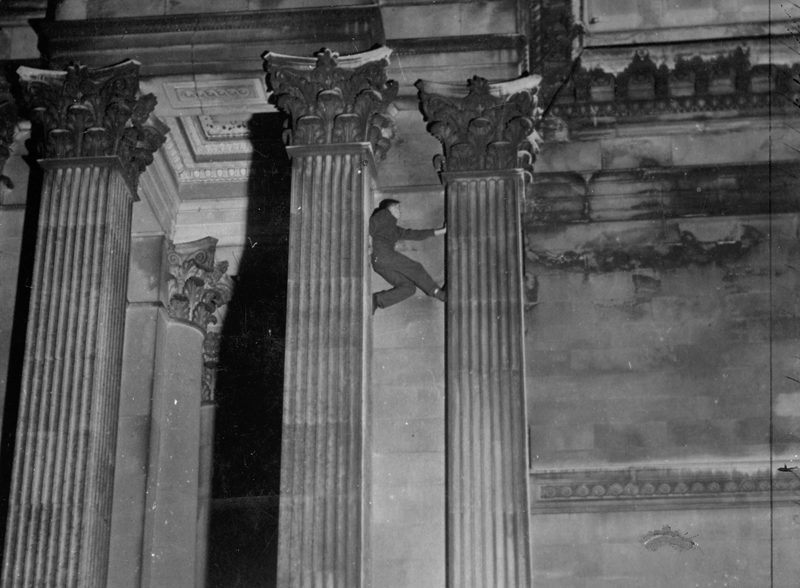
In Cambridge, buildering continued in a quieter and more private form. In 1921, undergraduates from St John’s College published a guide to climbing their college buildings. Further editions of the Trinity College guide appeared in 1930 and 1960, reflecting the persistence of the tradition. In 1937, a detailed and lightly humorous account of undergraduate night climbing was published under the pseudonym “Whipplesnaith,” later revealed to be Noël Howard Symington. Night climbing remained part of Cambridge student culture in the decades following the Second World War, with additional books and memoirs appearing through the 1970s.
The second half of the twentieth century saw buildering expand to increasingly tall and prominent structures. In 1947, John Ciampa climbed the exterior of the Astor Hotel in New York City.
In the 1960s, climbers in Vancouver practised for Squamish on the walls of university buildings. In a story for Gripped, Ivan Hughes wrote: “Tim Auger quickly glanced over his shoulder. The campus security guard hadn’t noticed him standing there with a Goldline hawser rope coiled at his feet. Auger recognized him because he looked like the guard that had caught him on the roof of the Chemistry Building a couple of weeks earlier, that was a climb that could have got him in trouble… Auger, a student in Arts and Science at the University of British Columbia, was having a good time with his friends at the Varsity Outdoor Club (VOC) as they ticked off ascents on the walls of many of the campus buildings, helping Dick Culbert collect routes for his new guidebook, A Cragrats’ Guide to the UBC Campus.” Read the story here, and see the guidebook here.
In 1977, George Willig climbed the South Tower of the World Trade Center. During the 1980s, Dan Goodwin climbed many of the world’s tallest buildings, including the Sears Tower, the John Hancock Center, and the CN Tower, often to draw attention to issues of fire safety and rescue in high rise buildings.
From the 1990s onward, buildering became strongly associated with Alain Robert, a French climber born in 1962. Robert climbed major landmarks around the world, including the Empire State Building, the Petronas Towers, Taipei 101, and the Burj Khalifa. While most of his climbs were completed without protection, his climb of the Burj Khalifa in 2011 was carried out using a harness in accordance with local safety requirements. His solos have brought sustained global attention to urban soloing.
In the late 2000s, buildering entered a new phase with the rise of online video platforms. Climbers in Eastern Europe, particularly in Russia and Ukraine, began sharing recordings of rooftop and crane ascents, often referring to the activity as roofing. This was during the boom of parkour and YouTube videos, which led to more people around the world watching urban climbing.
Between 2007 and 2011, several classic guides to Cambridge night climbing were reprinted, making earlier sources widely available. In 2025, Jordan Schultz published Campusing: A Secret History and Buildering Guide to UC Berkeley, combining a detailed historical account with a modern guide.
Over the past decade, several new climbers have picked up the sport, including Alexis Landot, who’s soloed several skyscrapers, sometimes in bare feet.
Over the past 20 years, Honnold has become one of the greatest free solo climbers of all time. His solos are epic, bold, historic and inspiring, just this month he pulled off a 43-pitch linkup in Red Rock, read about it here. His planned climb of Taipei 101 has been widely promoted as the largest urban free solo attempt to date. This framing has prompted discussion within the climbing communities about the distinction between exploratory ascent and mediated performance. In an interview conducted prior to the event, Dan Goodwin offered a critical assessment of the project’s context and presentation.
He described the planned ascent as “the intersection of high-performance athletics and commercial entertainment,” characterizing it as essentially a choreographed production intended primarily to support a streaming platform. While emphasising that this observation was not meant as a criticism of the platform itself, Goodwin argued that such projects differ in kind from earlier forms of building climbing, which were marked by uncertainty and limited public mediation. Read the interview here.
For more information on Honnold’s Taipai 101 free solo, visit here.
(UPDATE Jan. 23: Honnold’s free solo of Taipei 101 has been postponed, more info here)
The post How We Arrived at Alex Honnold Free Soloing Taipei 101 appeared first on Gripped Magazine.